Subscribe to John’s newsletter!
Read the latest issue (August 2026) here:
Dispatches From The Compound
From the hills of West Virginia, where curiosity frequently outruns common sense.
A Once-In-A-Lifetime Opportunity: Attending the Dedication of A New Warship
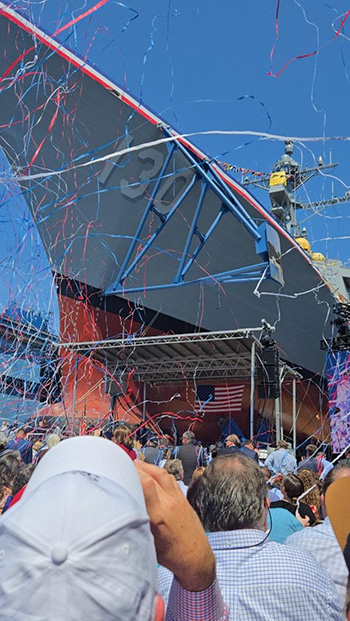
Dedication of the USS William Charette (DDG 130)
Being an author admittedly comes with some pretty cool perks. Most recently, I was invited by my friend and fellow author Claude Berube to attend the dedication of the brand new Arleigh Burke-class guided missile cruiser, the USS William Charette (DDG 130) at the Bath Iron Works in Bath, Maine. Watching one of these ships tower over the docks, it’s impossible not to appreciate the engineering and firepower packed into a single hull.
I’m embarrassed to confess that I had never heard of William “Doc” Charette before attending the christening. Hospital Corpsman Third Class Doc Charette was attached to Company F, 2nd Battalion, 7th Marines, 1st Marine Division, In Panmunjom, Korea when, on March 27, 1953, he displayed stunning acts of courage for which President Dwight D. Eisenhower awarded him the Congressional Medal of Honor. (Read the complete Medal of Honor citation here.) Doc went on to serve 26 years in the Navy, finally retiring in 1977 as a master chief hospital corpsmen. Among his many honors, Master Chief Charette was assigned to select the remains of servicemen from the Pacific and Atlantic theaters of World War Two to be placed in the Tomb of the Unknowns in Arlington National Cemetery.
The ceremony featured wonderful displays of American patriotism. Featured speakers included Susan Collins (R) and Angus King (I), the senior and junior senators from Maine, with the featured address delivered by the Honorable Hung Cao, acting Secretary of War. Vietnam-era Medal of Honor Recipient Harvey C. Barnum, Jr. schooled every politician within earshot of the lasting importance of a stronger United States Navy.
On that beautiful August 1 morning, though, the most memorable presentations came not from the politicians and the war fighters, but rather from Doc Charette’s son and daughter, who talked about “Pops” and “Daddy.” Their speeches reminded us of the humanity of our heroes. While other presenters spoke of bravery under fire, his children shared stories of a backseat stuffed with pillows for long car rides that always started at night so the family could sleep. It’s so very touching to me that the same man who risked his life for his Marines also loved to sing along with songs on the car radio.
Well-Behaved Characters
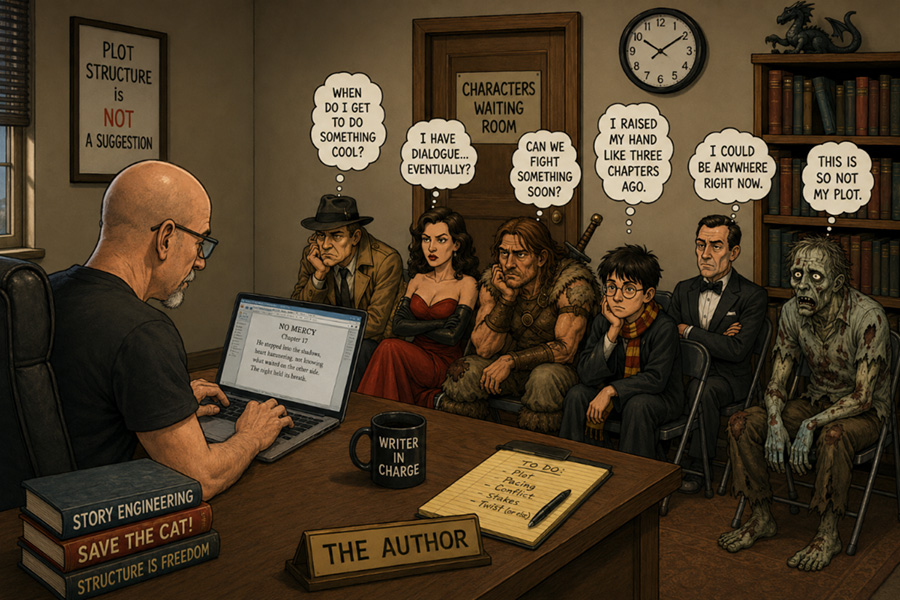
I wrote this a while ago, but it’s still true . . .
Like most authors, I suppose, I teach a number of writing classes and attend my share of conferences, and one of the questions that always comes up goes something like this: “I hear authors talk about how there comes a point in every story when the characters take over and start writing the story for you. Does that happen to you?”
The short answer is no; and frankly, it sort of ticks me off. I’d love to cede the process of plot development to my characters. Hell, somewhere in the middle of the second act, where all the tedious stuff is being manipulated and I’ve got to keep the pacing going, I’d cede the process to a stranger in a grocery store if he could make it any less painful.
As it is, my characters just sit there and wait to be told what to do. Lazy bastards. Not an original thought from any of them. In fact, during those tough times when I’ve written myself into a corner and don’t know how to extricate myself, I believe I’ve seen them chuckling at my plight. If I didn’t need the characters to make the story work, I swear sometimes that I’d fire them all.
I faced a storytelling crisis a few books ago. Staring down the throat of a deadline, I needed an ending. I mean, I already had an ending from the initial drafts, but I needed an ending. A kick-ass final sequence that would leave the reader exhausted and satisfied. The one I already had took care of the satisfaction part, but it didn’t have the roller coaster feel that I wanted.
So I shot one of the characters.
Don’t worry, it wasn’t a gratuitous thing. The shooting is organic to the plot, and it provided the twist I needed. It also wiped those sanctimonious smirks off those lazy bones’ faces. Sometimes it helps to remind them of the power I have over their lives.
In that moment, I think I discovered what authors really mean when they talk about characters taking over. By shooting that character, I gave the other characters in the scene something to react to. Things started happening and new twists occurred to me as I wrote. I got really into the scene. The characters’ reality became so much my own reality that all I had to do was observe and record what I saw in my imagination. It was one of those moments of high concentration that I think every writer adores. When I finished and went back and read the thirty pages I’d written, I loved it. I’d nailed it.
When I’m in the zone, writing fiction has a lot in common with what I understand method acting to be. As the creator of characters, I spend a lot of time in their head space. Every action they take is the result of some plot-related motivation, and over time I come to understand those motivations. As plot twists come along—triggered by the actions of other characters whose motivations I’ve come to understand even as the rest of the cast have not—the reaction becomes obvious.
It’s not about them telling me what to do; it’s about me drawing them clearly enough to know what they’d do on their own if they were real enough to walk among us.
I do love this job.
Around the Compound . . .
Mass market vs. trade paper. The results are in. In the July issue of Dispatches, I asked you for your thoughts about the global movement away from mass market paperback to the trade paper format for books. After hearing from some of you (a couple of dozen responders), there’s no clear consensus. While no one likes to pay more—and let me reiterate that I have no say over the pricing of my books—an equal number prefer the easier readability of the larger format versus the convenient size of the mass market paperback. What surprised me was how many readers have moved away from paper altogether in favor of eBooks and audio formats.
Kimber’s Corner
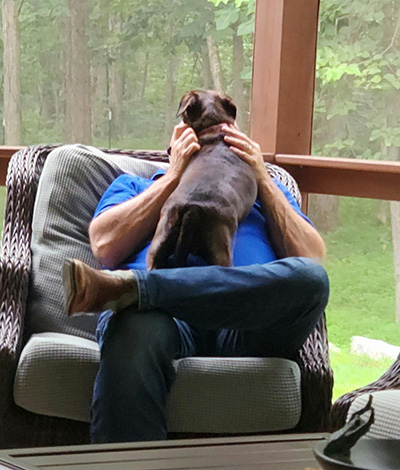
In Kimber’s words . . .
The security condition changes quickly here at the compound. I don’t like to boast, but fortunately, someone captured photographic evidence of me swinging into action.
Dad and I were sitting on the back porch on a hot day, listening to the rain pounding on the other side of the screen. I pretended to sleep on the cool concrete floor, making that snoring sound I use to communicate that I am relaxed and that all is well.
Then, without warning, a boom from the clouds shook the house. Instantly, I launched myself into Dad’s lap and then sheltered him with my whole body.
No thanks are necessary. It’s what we security experts were born to do.
Love,
Kimber
Undefeated Defender of the Compound